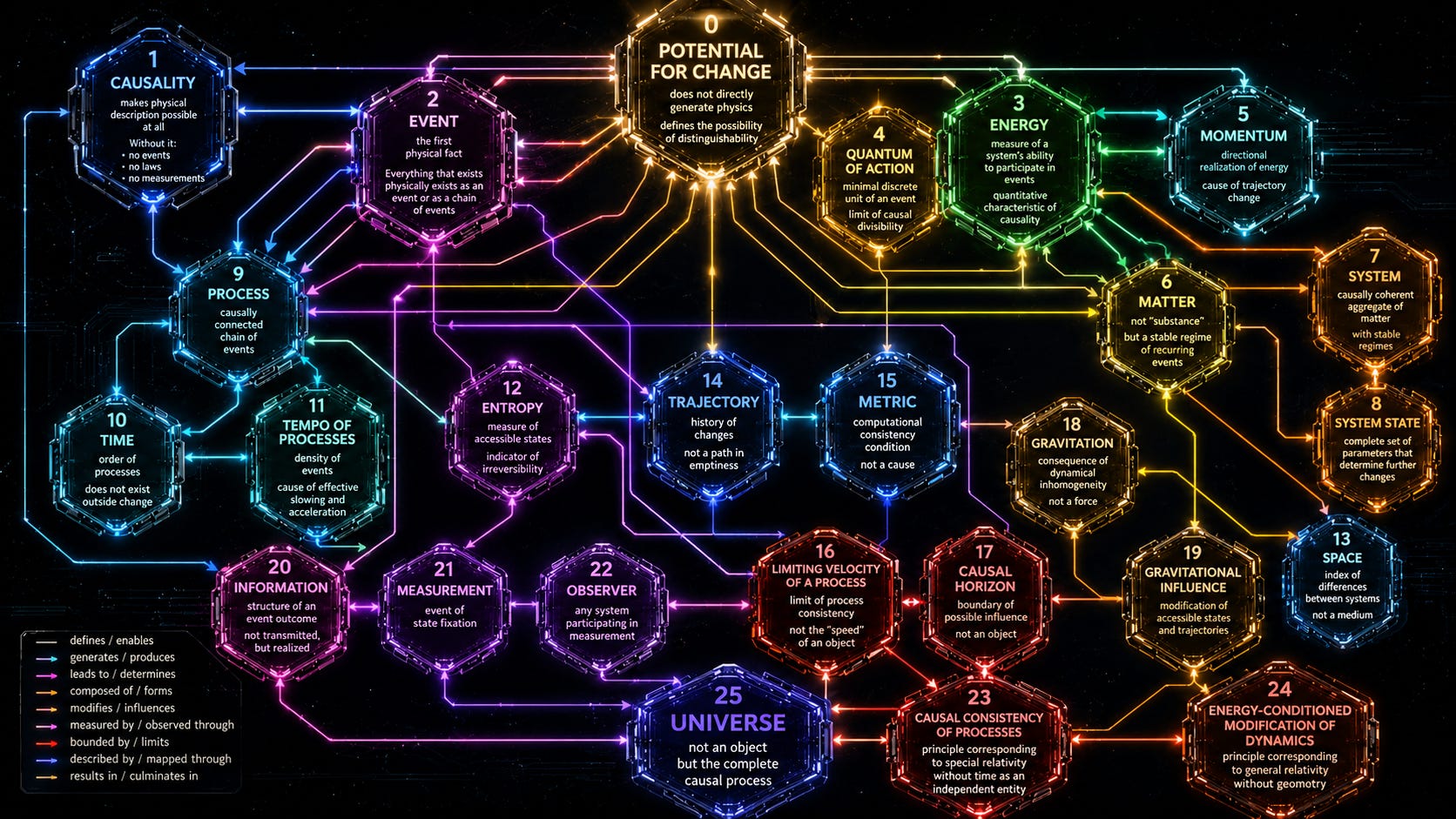

Format:
A → B means: B is causally impossible without A.
CAUSAL GRAPH OF CONCEPTS
(Canonical, Directed, Acyclic)
LOGICAL BOUNDARY OF PHYSICS
0. Potential for Change
→ does not directly generate physics
→ defines the possibility of distinguishability
This lies outside the physical graph, but forms its logical boundary.
ENTRY INTO PHYSICS
1. Causality
→ makes physical description possible at all
Without it:
no events
no laws
no measurements
MINIMAL REALITY
1. Causality → 2. Event
Event — the first physical fact.
Everything that exists physically exists as an event or as a chain of events.
DISCRETIZATION AND POWER
2. Event → 4. Quantum of Action
Quantum of Action:
minimal discrete unit of an event
limit of causal divisibility
2. Event → 3. Energy
Energy:
measure of a system’s ability to participate in events
quantitative characteristic of causality
DIRECTIONALITY AND INTERACTION
3. Energy → 5. Momentum
Momentum:
directional realization of energy
cause of trajectory change
STABILITY
3. Energy + 2. Event → 6. Matter
Matter:
not “substance”
but a stable regime of recurring events
COMPOSITION
6. Matter → 7. System
System:
causally coherent aggregate of matter
with stable regimes
7. System → 8. System State
System State:
complete set of parameters that determine further changes
DYNAMICS
2. Event → 9. Process
Process:
causally connected chain of events
TIME AND IRREVERSIBILITY
9. Process → 10. Time
Time:
order of processes
does not exist outside change
9. Process + 2. Event → 11. Tempo of Processes
Tempo:
density of events
cause of effective slowing and acceleration
8. System State + 9. Process → 12. Entropy
Entropy:
measure of accessible states
indicator of irreversibility
DESCRIPTION OF DIFFERENCES
7. System → 13. Space
Space:
index of differences between systems
not a medium
9. Process → 14. Trajectory
Trajectory:
history of changes
not a path in emptiness
13. Space + 14. Trajectory → 15. Metric
Metric:
computational consistency condition
not a cause
CAUSAL LIMITS
1. Causality + 9. Process → 16. Limiting Velocity of a Process
This is:
limit of process consistency
not the “speed of an object”
16. Limiting Velocity of a Process → 17. Causal Horizon
Causal Horizon:
boundary of possible influence
not an object
GRAVITATION (NOT GEOMETRY)
3. Energy + 11. Tempo of Processes → 18. Gravitation
Gravitation:
consequence of dynamical inhomogeneity
not a force
18. Gravitation → 19. Gravitational Influence
Gravitational Influence:
modification of accessible states and trajectories
INFORMATION
2. Event → 20. Information
Information:
structure of an event outcome
not transmitted, but realized
20. Information + 7. System → 21. Measurement
Measurement:
event of state fixation
21. Measurement → 22. Observer
Observer:
any system participating in measurement
CAUSAL CONSISTENCY
16. Limiting Velocity of a Process + 21. Measurement → 23. Causal Consistency of Processes
This is:
the principle corresponding to special relativity
without time as an independent entity
18. Gravitation + 9. Process → 24. Energy-Conditioned Modification of Dynamics
This is:
the principle corresponding to general relativity
without geometry
CLOSURE
All of the above → 25. Universe
Universe:
not an object
but the complete causal process
FIXATION
1. The graph is acyclic (except permitted nested relations).
2. Each concept:
o has incoming causes
o and outgoing consequences (except terminal ones).
3. Any physical process is uniquely mappable onto this graph.
COMPLETION OF THE CANONICAL ONTOLOGY
1. Ontological Status
The canonical ontology is fixed as:
· a closed causal language of reality
· minimal in number of entities
· sufficient for describing any realizable process
· not extendable without violating causality
The ontology is not a theory.
It is an engineering language for process description.
2. Principle of Finiteness
The ontology is finite because:
· all processes are derived from a single causal graph
· all parameters reduce to a finite basis
· any “new concept” must reduce to:
o event
o system state
o process
o energy
o tempo
o trajectory
If reduction is impossible →
it is not a new element of reality, but a description error.
3. Prohibition of Vocabulary Expansion
A strict rule is fixed:
Introduction of new fundamental entities is prohibited.
Permitted only:
· refinement of process conditions
· modification of regimes
· engineering adjustment of parameters
· choice of scale
This makes the ontology:
· stable
· verifiable
· computable
4. Status of Classical Theories After Completion
After ontological fixation:
· Classical mechanics → approximation of canonical dynamics
· Quantum mechanics → statistical regime of canonical processes
· General relativity → consequence of inhomogeneous tempo
· Cosmology → specific regime of the complete causal graph
None of them has ontological priority.
5. Transition to Operational Use
From this point:
· construction is prohibited
· only the following are allowed:
o computation
o modeling
o prediction
o engineering control of regimes
The ontology is a completed system.


Listed below are the essential posts from all columns, reflecting the areas already reduced:


https://github.com/Genso-Akane/Causal_Ontology_Archive