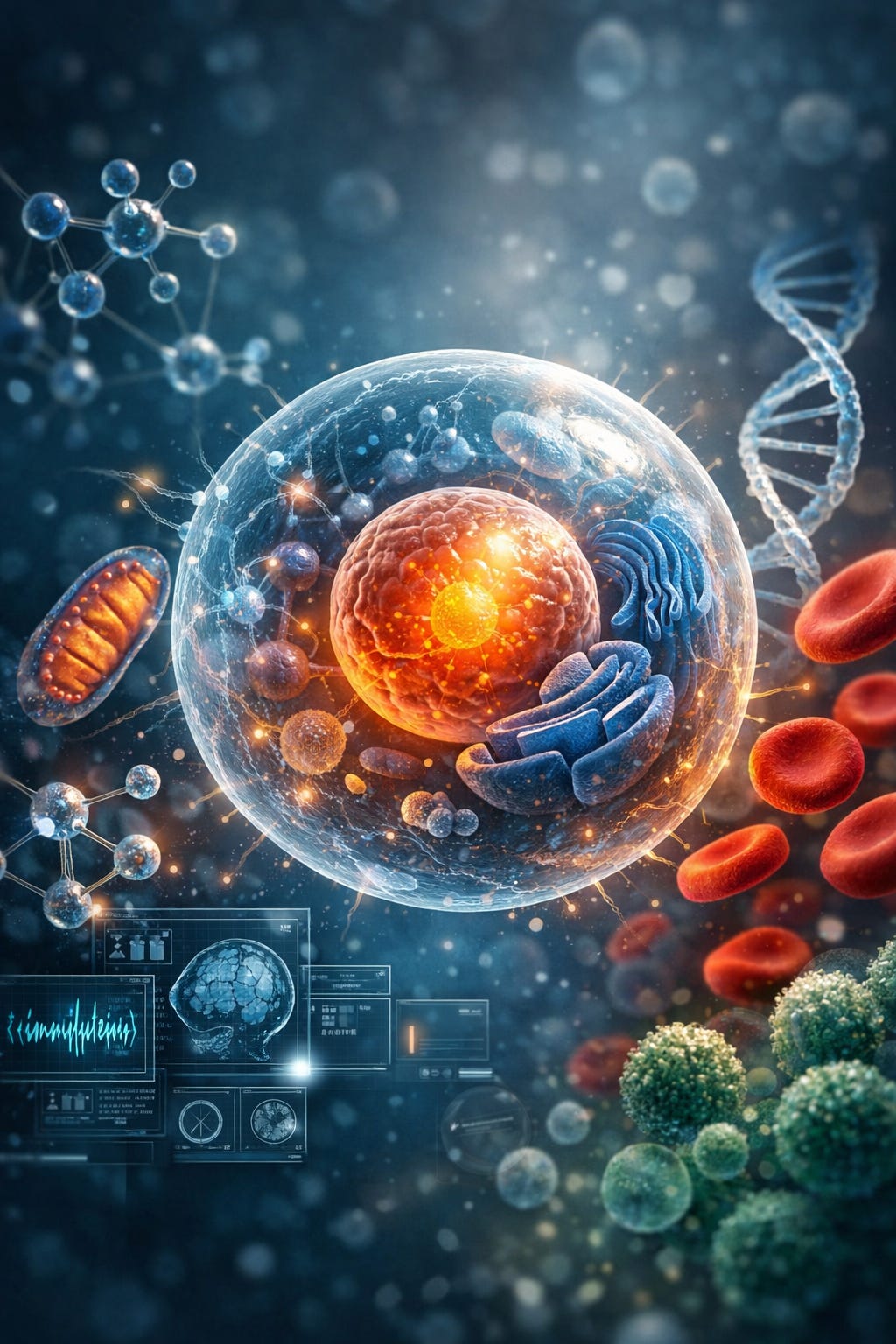
Biological Architecture: The Engineering of Life
Causal deconstruction of cellular foundations and organismal coordination

Do not call a cell a "building block of life." That is a metaphor for children. In Causal Physics, a cell is a high-density aggregate of matter maintaining a specific energetic regime against the background noise of the universe. An organism is not a miracle; it is a parallel-processing network of 7. Systems. If you want to understand biology, stop looking at "living tissue" and start looking at the feedback loops that keep the 8. System State from dissolving into thermodynamic equilibrium.
Causal Linkage: 3. Energy + 2. Event → 6. Matter → 7. System → 8. System State → 9. Process
Cause → Mechanism → Effect → Practical conclusion
Cause:
6. Matter
Mechanism:
3. Energy + 2. Event → 6. Matter
6. Matter → 7. System
7. System → 8. System State
2. Event → 9. Process
Matter is a stable regime of recurring events.
System is a causally coherent aggregate of matter with stable regimes.
System State defines parameters of further changes.
Process is a causally connected chain of events.
Effect:
6. Matter forms stable 7. System.
7. System is realized through 9. Process under defined 8. System State.
“Cell” is a 7. System with stable 8. System State and continuous 9. Process.
“Organism” is a composite 7. System of interacting 7. System coordinated through shared 9. Process and 8. System State.
Practical conclusion:
Control is performed through system state and processes.
Engineering:
— control is achieved through change of 8. System State
— stability is defined by regimes of 6. Matter
— functioning is determined by configuration of 9. Process
— coordination is achieved through control of processes between systems
Engineering Interpretation & Expansion
When we analyze biology through the Canonical Causal Graph, we remove the “vitalist” mystery. A cell is simply an engineered system that has achieved a stable 11. Tempo of Processes—a specific frequency of event chains that allows it to persist in time.
1. The Cell as a Causal Loop:
A cell is a regime of 6. Matter that has closed its own causal loops. It consumes 3. Energy to perform 9. Processes that repair the cell structure itself, effectively fighting 12. Entropy. The 8. System State of a cell is defined by a precise concentration of chemical parameters. If the cell fails to perform its internal 2. Events (metabolism), the 7. System loses its coherence, and the matter reverts to a state of equilibrium with the environment.
2. Organism as Parallel Computation:
An organism is a composite 7. System of interacting sub-systems (cells/organs). Coordination here is a problem of 23. Causal Consistency. Each sub-system operates on a local 9. Process, but their integration requires a shared 15. Metric (hormonal signaling, electrochemical gradients). The organism succeeds only if the 8. System State of all sub-systems remains within a narrow operational window.
3. The Engineering of Stability:
The “coordination” between systems in an organism is achieved by controlling the 11. Tempo. If one sub-system accelerates its 9. Process relative to the others (e.g., uncontrolled cell division), it creates a state of Dynamical Inhomogeneity—this is the physical root of cancer. Biological engineering is, therefore, the art of maintaining the synchrony of event chains across the entire aggregate of matter.
4. Energy-Conditioned Dynamics:
Biological systems are essentially engines for 24. Energy-Conditioned Modification of Dynamics. They are structured to optimize the intake of 3. Energy to maintain their 8. System State. When we speak of “survival,” we are talking about a system that has engineered its internal parameters to match the causal demands of its environment. Evolution, in this context, is not “trial and error,” but a physical search for configurations that maximize the 16. Limiting Velocity of Processes required for stable maintenance.
Note: The numbering refers to the Canonical Ontology — a specialized causal framework for system reduction.


Next:

LGM: The Hardware Specification of Universal Logic. Zenodo
https://github.com/Genso-Akane