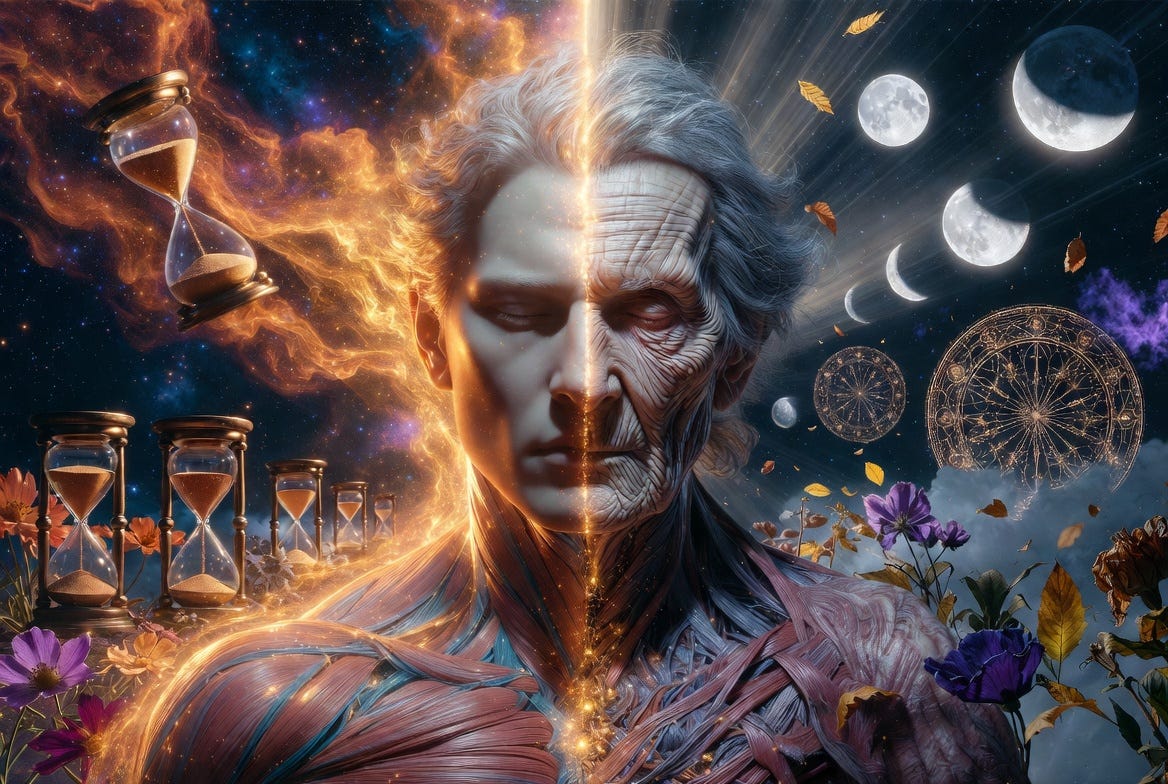
Biological Engineering: The Mechanics of Aging
Causal deconstruction of systemic decay and entropic accumulation

Aging is not a "biological clock" or a natural mystery—it is a steady increase in the count of accessible 8. System States. In Causal Physics, getting older is the physical accumulation of 12. Entropy within the 7. System. Death is simply the point where the number of possible states becomes so high that the 9. Process can no longer maintain the coherence of 6. Matter. To "stop" aging is to engineer a system that can reset its state-parameters faster than entropy can scramble them.
Causal Linkage: 7. System → 8. System State → 9. Process → 12. Entropy
Cause → Mechanism → Effect → Practical conclusion
Cause:
12. Entropy
Mechanism:
7. System → 8. System State
2. Event → 9. Process
8. System State + 9. Process → 12. Entropy
System State defines the complete set of parameters.
Process realizes a sequence of events.
Entropy is a measure of accessible states and an indicator of irreversibility.
Effect:
12. Entropy increases the number of accessible 8. System State.
Stable regimes of 7. System are disrupted through 9. Process.
“Aging” is growth of 12. Entropy in 7. System through 9. Process leading to change of 8. System State.
Practical conclusion:
Slowing requires control of processes and state.
Engineering:
— control is achieved through modification of 9. Process
— stability is defined by control of 8. System State
— slowing requires limiting growth of 12. Entropy
— recovery requires return to stable states
Engineering Interpretation & Expansion
Within the Canonical Causal Graph, Aging is the ultimate indicator of Irreversibility. It is the process by which a high-order 7. System gradually loses its specific configuration and dissolves back into the general background of the 25. Universe.
1. Entropy as State Proliferation: As a biological system operates, every 2. Event and 9. Process generates a residue of noise. This noise increases 12. Entropy, which is the measure of accessible states. In a “young” system, the 8. System State is tightly constrained to a few functional trajectories. In an “aging” system, the parameters drift, allowing the system to enter “invalid” or dysfunctional states. Aging is the physical manifestation of the system losing its ability to distinguish between its sanctioned operational path and random fluctuations.
2. The Irreversibility of Process: Because 10. Time is merely the order of processes, and 12. Entropy is the indicator of irreversibility, aging is a one-way vector of state-degradation. The 9. Process (metabolism, replication, repair) itself is the source of the decay. Each event cycle contributes to the wear on the 6. Matter regime. When the entropy of the aggregate reaches a critical threshold, the 23. Causal Consistency required for life can no longer be sustained.
3. Tempo and Decay Rate: The rate of aging is dictated by the 11. Tempo of Processes. A higher density of events (higher metabolic rate) typically leads to a faster accumulation of 12. Entropy. Biological engineering for “longevity” is the attempt to tune the 11. Tempo or optimize the 20. Information replication to ensure that each 2. Event produces the minimum possible entropy.
4. Engineering Rejuvenation: To “reverse” aging is an engineering problem of State Restoration. It requires a sequence of 21. Measurements to identify the drifted parameters of the 8. System State and an external input of 3. Energy to force the matter back into a low-entropy configuration. This is “re-coding” the system at the cellular level—overriding the current 9. Process to restore the structural integrity of the 7. System. True rejuvenation is not about masking symptoms; it is about physically reducing the number of accessible dysfunctional states.
Note: The numbering refers to the Canonical Ontology — a specialized causal framework for system reduction.


→ Back to the beginning:

Next series:


https://doi.org/10.5281/zenodo.19676696
https://github.com/Genso-Akane
GNU AFFERO GENERAL PUBLIC LICENSE Version 3