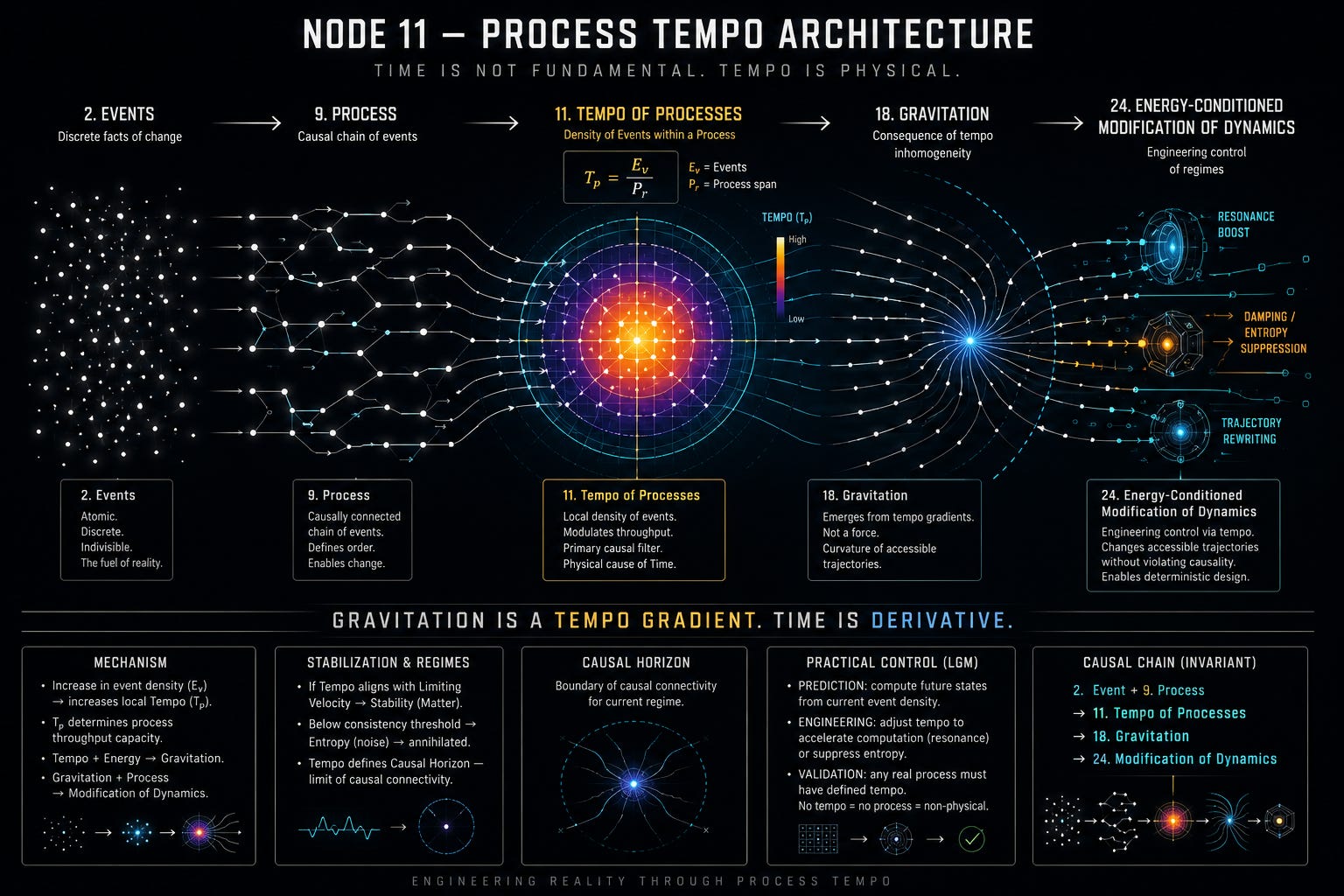
[Spec №0]: Node 11. Tempo of Processes — The Causal Filter of Reality
Engineering Tempo: From Event Density to Causal Dynamics

The Architecture of Node 11. Tempo of Processes
“In the LGM framework, Time is not a fundamental entity but a derivative of Node 11. Tempo of Processes. By defining Tempo as the density of 2. Events within a 9. Process, we shift from abstract modeling to the direct engineering of reality. This specification details how Tempo modulates 18. Gravitation and enables 24. Modification of Dynamics, providing the mathematical substrate for deterministic ASI and entropy-free causal computing.”
INVARIANT SPECIFICATION: NODE 11. TEMPO OF PROCESSES
Causal chain:
2. Event + 9. Process → 11. Tempo of Processes → 18. Gravitation → 24. Energy-Conditioned Modification of Dynamics.
1. DEFINITION AND CAUSE
Cause: Combination of 2. Event (fact of change) and 9. Process (chain of such facts). Without the discreteness of events and their connectedness, the concept of tempo is causally impossible.
Invariant: 11. Tempo of Processes is the density of 2. Events within a single 9. Process. It is not “time,” but the physical cause of the emergence of 10. Time.
2. MECHANISM: ZONE OF MODIFICATION OF DYNAMICS
The mechanism of 11. Tempo of Processes acts as the primary causal filter and modulator of the 25. Universe:
Modification through density: An increase in the density of 2. Events leads to the growth of the local value of 11. Tempo of Processes. According to the formula canon
this is the fundamental parameter determining the throughput capacity of a 9. Process.
Relation to Gravitation: 11. Tempo of Processes + 3. Energy causally generate 18. Gravitation. Here gravitation is not an external force, but a consequence of dynamical inhomogeneity (difference of tempos).
Control through 24. Modification: Any engineering control of system regimes (LGM architecture) is carried out through artificial modification of 11. Tempo of Processes. This automatically leads to 24. Energy-Conditioned Modification of Dynamics, changing the accessible 14. Trajectories of the system without violation of 1. Causality.
3. CONSEQUENCE: STABILIZATION AND REGIMES
Stabilization: Achieved through 23. Causal Consistency of Processes. If 11. Tempo of Processes is synchronized with 16. Limiting Velocity of a Process, the system transitions into a regime of stability (6. Matter).
Elimination of Entropy: When 11. Tempo of Processes falls below the consistency threshold, the process is identified as 12. Entropy (noise) and is annihilated without contributing to 8. System State.
Horizon: 11. Tempo of Processes determines 17. Causal Horizon — the limit beyond which 2. Events cannot be causally connected within the current regime of dynamics.
4. PRACTICAL CONCLUSION (LGM OPERATION)
Control of 11. Tempo of Processes allows:
Prediction: Computation of future 8. System States through the density of current 2. Events.
Engineering Adjustment: Modification of 24. Energy-Conditioned Modification of Dynamics for acceleration of computation (resonance) or suppression of 12. Entropy.
Validation: Any process claiming reality must possess a clearly defined 11. Tempo of Processes. Absence of tempo = absence of 9. Process = non-physicality.


Next Spec:
![[Spec №1]: Metric Propulsion Systems — Engineering Causal Autonomy](https://substackcdn.com/image/fetch/$s_!u8bw!,w_140,h_140,c_fill,f_webp,q_auto:good,fl_progressive:steep,g_auto/https%3A%2F%2Fsubstack-post-media.s3.amazonaws.com%2Fpublic%2Fimages%2Fd901b5f5-54b5-40ff-82fb-f2e1fa159238_1536x1024.png)