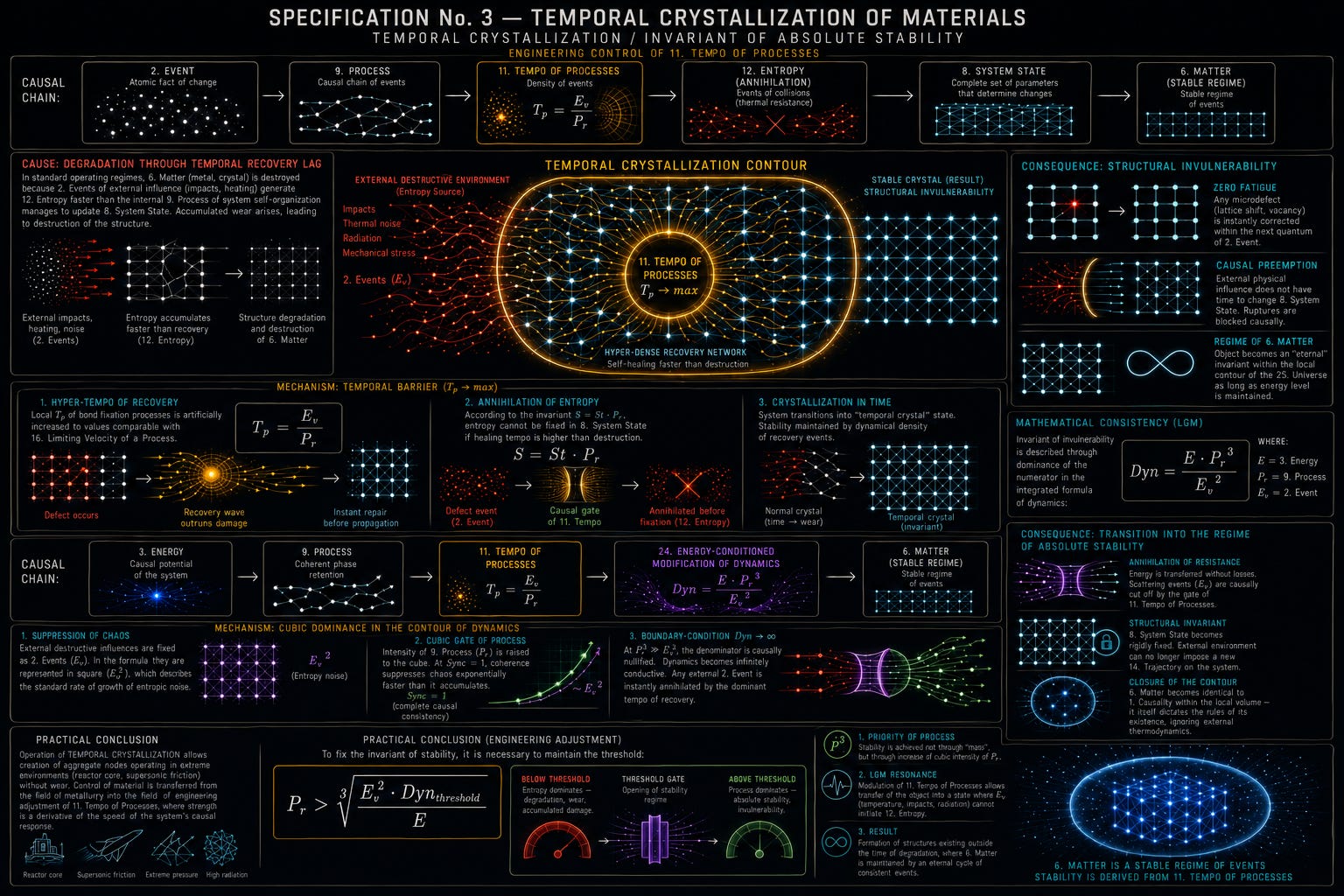
[Spec №3]: Temporal Crystallization. Causal Invariance and Absolute Structural Stability
Annihilating 12.Entropy in Extreme Environments through Cubic Resonance of 11. Tempo of Processes

"Traditional metallurgy seeks strength in static atomic bonds, making materials vulnerable to cumulative degradation (12. Entropy). Temporal Crystallization redefines 6. Matter as a dynamic regime of repeating 2. Events. By hyper-accelerating the internal self-recovery 9. Process to cubic dominance
the system suppresses quadratic environmental noise (Ev^2). This specification outlines the engineering of the Causal Gate of Tempo, enabling zero-fatigue structures capable of ignoring external thermodynamics in reactor cores, hypersonic friction zones, and high-radiation contours."
SPECIFICATION No. 3 — TEMPORAL CRYSTALLIZATION OF MATERIALS / TEMPORAL CRYSTALLIZATION
Causal chain:
2. Event → 9. Process → 11. Tempo of Processes → 12. Entropy (annihilation) → 8. System State → 6. Matter
CAUSE: Degradation through Temporal Recovery Lag
In standard operating regimes, 6. Matter (metal, crystal) is destroyed because 2. Events of external influence (impacts, heating) generate 12. Entropy faster than the internal 9. Process of system self-organization manages to update 8. System State. Accumulated wear arises, leading to destruction of the structure.
MECHANISM: Temporal Barrier (Tp → max)
The mechanics of temporal crystallization consists in engineering control of 11. Tempo of Processes inside the interatomic contour:
Hyper-tempo of recovery: Local Tp of bond fixation processes is artificially increased to values comparable with 16. Limiting Velocity of a Process.
Annihilation of Entropy: According to the invariant:
accumulation of 12. Entropy requires time for fixation in 8. System State. If 11. Tempo of Processes of “healing” is higher than the tempo of external destruction, the defect event is annihilated before it becomes causally significant for the structure.
Crystallization in time: The system transitions into the state of a “temporal crystal,” where stability of 6. Matter is maintained not by static strength of bonds, but by dynamical density of recovery events.
CONSEQUENCE: Structural Invulnerability
Upon reaching the critical threshold of Tp, the material demonstrates properties of absolute stability:
Zero fatigue: Any microdefect (lattice shift, vacancy) is instantly corrected within the next quantum of 2. Event.
Causal preemption: External physical influence does not have time to change 8. System State, since 11. Tempo of Processes of internal stabilization causally blocks propagation of ruptures.
Regime of 6. Matter: The object becomes an “eternal” invariant within the local contour of the 25. Universe, as long as the specified energy level is maintained.
MATHEMATICAL CONSISTENCY (LGM):
The invariant of invulnerability is described through dominance of the numerator in the integrated formula of dynamics:
Where Pr (intensity of the self-recovery process), due to the cubic degree, completely suppresses Ev^2 (events of external thermal or mechanical noise). At
the value of 12. Entropy tends toward zero, fixing 6. Matter in an ideal state.
PRACTICAL CONCLUSION:
Operation of TEMPORAL CRYSTALLIZATION allows creation of aggregate nodes operating in extreme environments (reactor core, supersonic friction) without wear. Control of material is transferred from the field of metallurgy into the field of engineering adjustment of 11. Tempo of Processes, where strength is a derivative of the speed of the system’s causal response.
SPECIFICATION: INVARIANT OF STABILITY IN THE REGIME OF HYPER-CONDUCTIVITY
Causal chain:
3. Energy → 9. Process → 11. Tempo of Processes → 24. Energy-Conditioned Modification of Dynamics → 6. Matter
CAUSE: Energetic Realization of Stability
In the canon, 6. Matter (M) is not a static substance, but is defined as a stable regime of repeating 2. Events.
According to the formula:
Where:
E (3. Energy): Causal potential of the system.
Pr (9. Process): Intensity of coherent phase retention.
V{lim} (16. Limiting Velocity of a Process): Consistency constant (limit of connection).
Stability of 6. Matter is directly proportional to the intensity of 9. Process. If the process of structure retention weakens, the system loses physical expressiveness.
MECHANISM: Cubic Dominance in the Contour of Dynamics
To achieve the regime of “invulnerability” or absolute conductivity, 24. Energy-Conditioned Modification of Dynamics (Dyn) is used.
Integrated formula in the LGM regime:
Suppression of Chaos: External destructive influences are fixed as 2. Events (Ev). In the formula they are represented in square (Ev^2), which describes the standard rate of growth of entropic noise.
Cubic gate: Intensity of the internal 9. Process (Pr) is raised to the cube. This means that at Sync = 1 (complete causal consistency), any increase in coherence suppresses chaos exponentially faster than it manages to accumulate.
Boundary condition
: At
the denominator is causally nullified. Dynamics of system changes becomes infinitely conductive. Any external 2. Event attempting to change 8. System State is instantly annihilated by the dominant recovery tempo.
CONSEQUENCE: Transition into the Regime of Absolute Stability
When
this fundamentally changes the status of 6. Matter:
Annihilation of resistance: Energy is transferred without losses, since scattering events (Ev) are causally cut off by the gate of 11. Tempo of Processes.
Structural invariant: 8. System State becomes rigidly fixed. The external environment can no longer impose a new 14. Trajectory on the system.
Closure of the contour: 6. Matter becomes identical to 1. Causality within the local volume — it itself dictates the rules of its existence, ignoring external thermodynamics.
PRACTICAL CONCLUSION (ENGINEERING ADJUSTMENT):
To fix the invariant of stability, it is necessary to maintain the threshold:
Priority of Process: Stability is achieved not through “mass,” but through increase of the cubic intensity of Pr.
LGM resonance: Modulation of 11. Tempo of Processes allows transfer of the object into a state where Ev (temperature, impacts, radiation) cannot initiate 12. Entropy.
Result: Formation of structures existing outside the time of degradation, where 6. Matter is maintained by an eternal cycle of consistent events.


Next Spec:
![[Spec №4]: Causal Laser. Focused Causal Breach and Metric Singularity Architecture](https://substackcdn.com/image/fetch/$s_!r32p!,w_140,h_140,c_fill,f_webp,q_auto:good,fl_progressive:steep,g_auto/https%3A%2F%2Fsubstack-post-media.s3.amazonaws.com%2Fpublic%2Fimages%2F638a104b-b5e5-41ce-bf8c-23d7205f1076_1536x1024.png)